
Yantra — an instrument of control
A mind that works for you.
A memory it keeps.
A desktop it acts on.
Yantrik is a small family of open-source pieces that fit together into one instrument. YantrikDB remembers. Yantrik Mind thinks and acts. Yantrik OS is the desktop it acts on, and the door any other agent comes in through. You hold it.
Start with the memory Watch the desktop, live Nightly ISO
It is early. YantrikDB is in daily use and on PyPI and crates.io; the OS ships a nightly build; the Mind is being built in the open. Everything below links to the real thing.
The Yantrik emblem, read inside-out. Hover a layer, or scroll.
01 · the bindu
You hold it.
Everything in Yantrik converges on one person. Minds work for you in Mind View, a view of their own: they cannot move your windows or take your focus. One known exception, being fixed: if your own browser was open first, a Mind's web tools can reach it, so don't leave it signed in while a Mind works. In the default mode, anything destructive asks you first. So do actions on the OS and sending email, each with a card showing the full text. Not every route off the machine asks yet; the rest are being put behind the same card, in changes that are open and not yet merged. What a Mind did is on record afterwards, with the tool it ran, how long it took, and what it touched.

02 · the lattice
Minds that remember what they believe.
Yantrik Mind is a Rust agent built on YantrikDB's typed memory. It does not keep notes as flat text: it keeps beliefs, each with a confidence score, an evidence trail and, where two disagree, a contradiction edge. New evidence revises confidence the Bayesian way. When it researches a question it recalls what it already believed, checks it against live sources, and tells you when the two disagree rather than asserting either. Conversations are consolidated into durable beliefs instead of being truncated.
Everything it can do sits behind one deterministic harm gate. Sub-agents can propose an outward action; none of them can confirm one.
It is not the only mind. Claude Code, Hermes, OpenClaw and Pi use YantrikDB too, through an MCP server or a Hermes plugin, and reach the same desktop through the gates.
03 · the strata
One memory, kept on your machine.
YantrikDB is a local-first cognitive memory engine: one SQLite file on your machine, built so every mind there can share it. On today's Yantrik OS image each harness is still installed with its own store, and the shared mode is in progress. It consolidates many notes into one fact. It notices contradictions and keeps both sides until someone decides. It keeps history, so you can ask what it believed in March. And it explains why it recalled something, including when the memory is old or rarely confirmed. It is a Rust library with Python bindings, an HTTP server, an MCP server for Claude Code, Cursor and Windsurf, and a memory provider for Hermes.
Of the pieces here, it is the one with the most use today.
# Python
pip install yantrikdb
# Rust
cargo add yantrikdb- yantrikdb-serverHTTP gateway, MCP server, cluster178★
- yantrikdb-hermes-pluginmemory provider for hermes-agent95★
- yantrikdbthe engine: Rust library, Python bindings71★
- yantrikdb-mcpdrop-in MCP server25★
yantrikdb.com · PyPI · crates.io · version 0.23.4, stars as of 2 Nov 2026
04 · the gear
A desktop built to be driven.
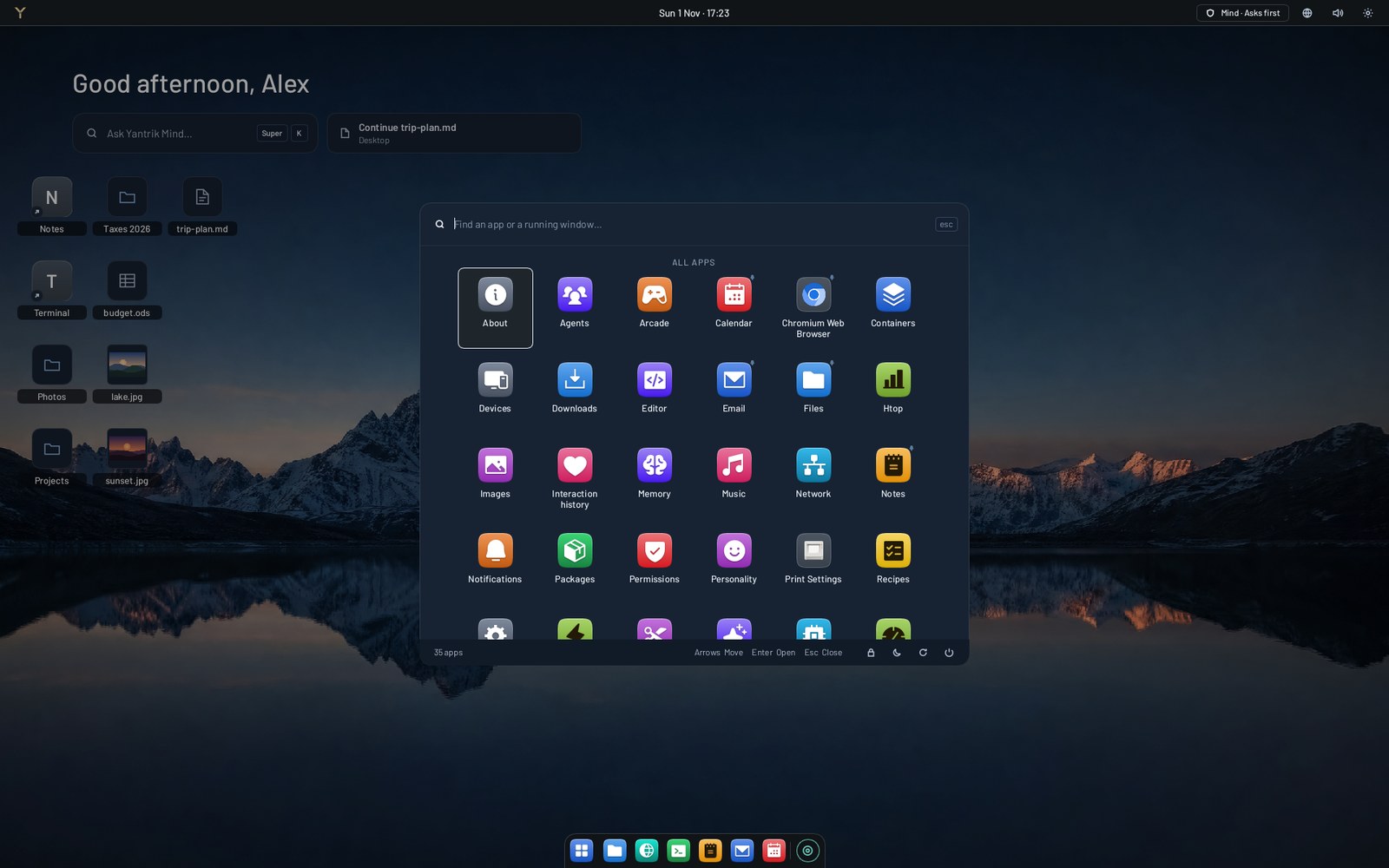
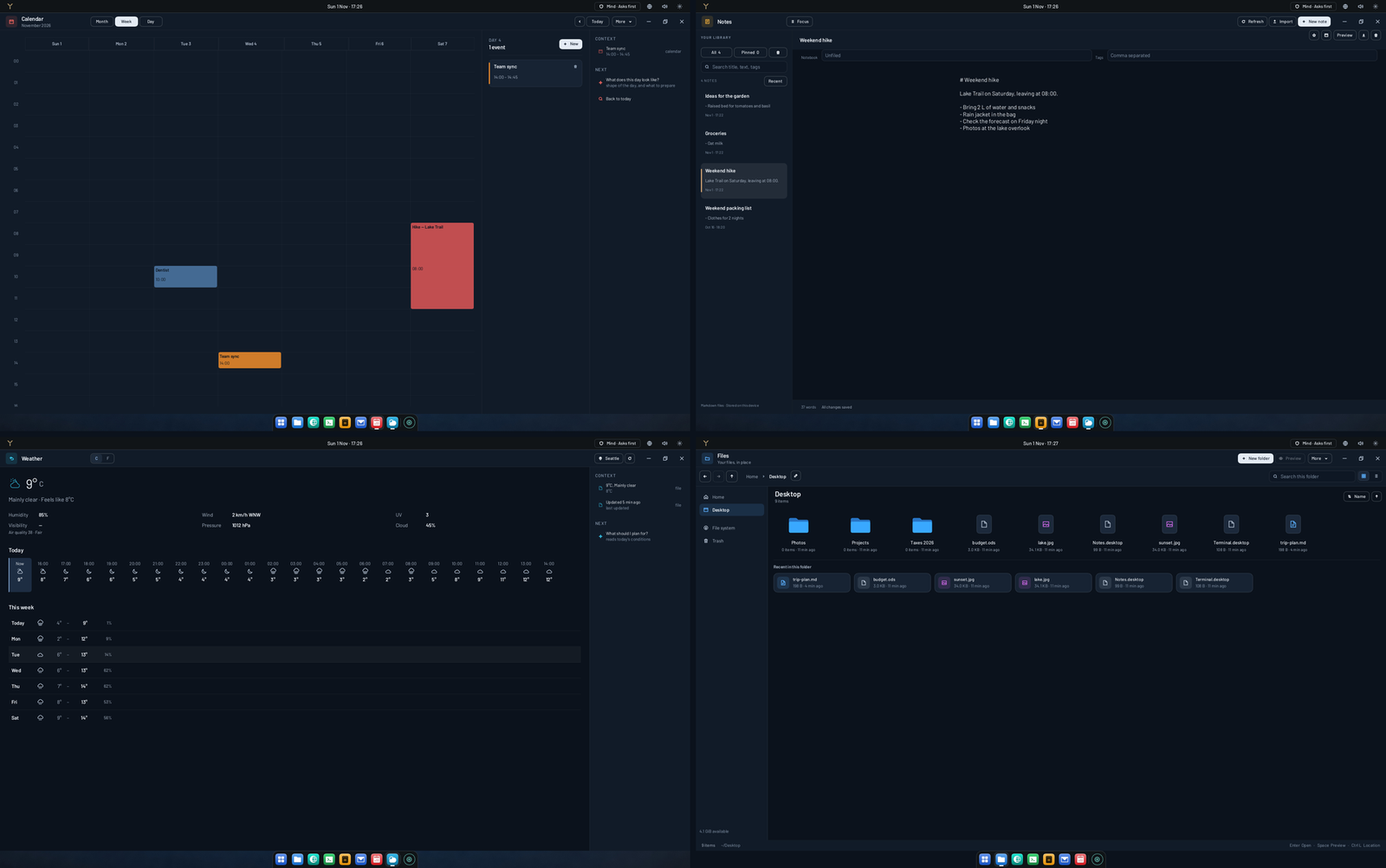
Yantrik OS is an AI-native Linux desktop. It is a real desktop first: the Bench, with your files and folders on it; a launcher; apps on one framework (19 of its 21 apps today), so Notes, Calendar, Weather, Terminal and the rest behave alike; updates that are signed (ed25519), verified before install, and rolled back with one command. What makes it different is that every app publishes a control surface, so a Mind can read it and act on it the way you would, and you can watch.
It is early. Builds are nightly, and rough edges are part of the deal. You can boot the ISO in a VM, or watch a machine running it right now.
05 · the gates
One door for every agent.
Every yantra stands inside four gates. Here they are the control surface: one way in, for any agent. yos describe returns what an app is showing, as text and as JSON with a revision. yos act changes it. Claude Code, Hermes, OpenClaw, Pi and Yantrik's own Mind all use the same door, so the rules at the door apply to all of them, and what each one did is on record.
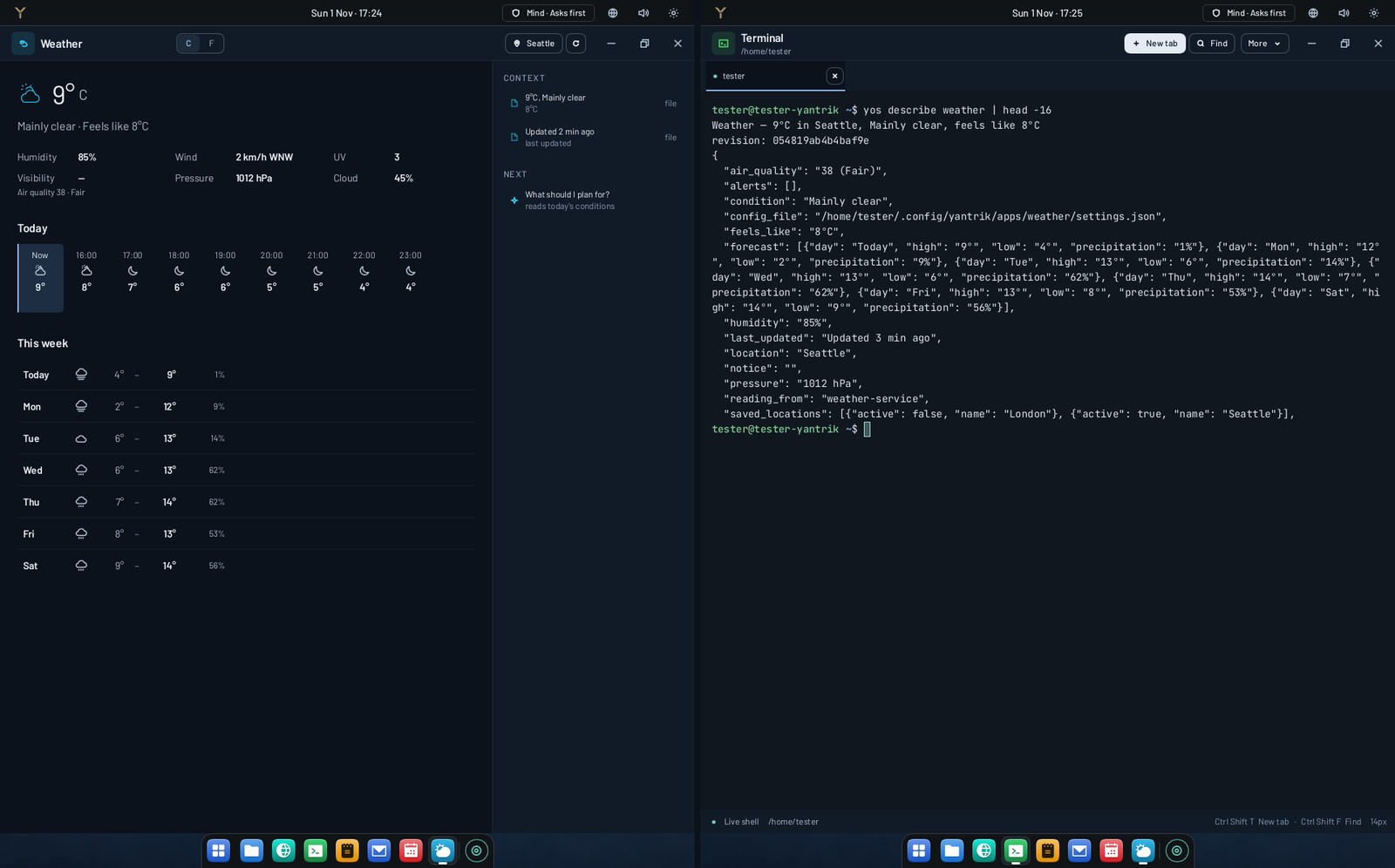
yos describe weather reading it from a terminal: the same facts, a revision id, no screenshot needed.